
Blood sugar shows up on lab reports and home meters in several different ways, and each one has its own cutoffs. A fasting glucose of 110 means something very different from a reading of 110 an hour after lunch. This guide puts the numbers side by side so you can see where yours fits, and what to ask next.
The blood sugar chart
These are the thresholds doctors use to sort results into normal, prediabetes, and diabetes. Find the test that matches yours, then read across.
| Test | Normal | Prediabetes | Diabetes |
|---|---|---|---|
| Fasting blood sugar no food for 8+ hours | Below 100 mg/dL below 5.6 mmol/L | 100 to 125 mg/dL 5.6 to 6.9 | 126 mg/dL or higher 7.0 or higher |
| 2-hour glucose tolerance test | Below 140 mg/dL below 7.8 | 140 to 199 mg/dL 7.8 to 11.0 | 200 mg/dL or higher 11.1 or higher |
| A1C | Below 5.7% | 5.7% to 6.4% | 6.5% or higher |
| Random blood sugar | Not used for normal or prediabetes | 200 mg/dL or higher with classic symptoms | |
Diagnostic thresholds from the American Diabetes Association and CDC, for adults who are not pregnant. A diagnosis is usually confirmed with a second test unless symptoms are clear. mmol/L = mg/dL ÷ 18.
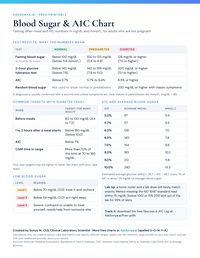 Free printable · PDFBlood Sugar & A1C ChartFasting, after-meal, A1C and low-sugar levels on one page, in mg/dL and mmol/L.
Download free
Fasting vs. after meals
A fasting blood sugar is taken after at least eight hours without food, usually first thing in the morning. It shows your baseline: how well your body keeps sugar steady when you are not eating.
After you eat, blood sugar rises and then comes back down. In people without diabetes, it usually returns below 140 mg/dL within about two hours. The 2-hour glucose tolerance test measures exactly that, using a standard sugar drink so results can be compared.
An A1C is different again: it reflects your average over the past two to three months. See the A1C chart to turn your A1C into an average blood sugar number.
Common targets if you have diabetes
Once someone has diabetes, the question changes from "is this normal?" to "is this on target?" These are the starting goals the American Diabetes Association suggests for many adults:
| When | Common target for many adults with diabetes |
|---|---|
| Before meals | 80 to 130 mg/dL (4.4 to 7.2 mmol/L) |
| 1 to 2 hours after a meal starts | Below 180 mg/dL (below 10.0 mmol/L) |
| A1C | Below 7% |
| CGM time in range | More than 70% of readings between 70 and 180 mg/dL |
From the American Diabetes Association Standards of Care. Many people have personal targets that are a little higher or lower; set yours with your care team.
Low blood sugar levels
Low blood sugar (hypoglycemia) mostly affects people who take insulin or certain diabetes medicines. It is grouped into three levels:
| Level | Reading | What it means |
|---|---|---|
| Level 1 | Below 70 mg/dL (3.9) | Low. Treat it and recheck, following your care plan. |
| Level 2 | Below 54 mg/dL (3.0) | Clinically significant low. Act right away. |
| Level 3 | Any reading | Severe: confused or unable to treat yourself, needing help from someone else. This is an emergency. |
Hypoglycemia levels as defined by the American Diabetes Association.
If you have diabetes and see a low reading, follow the plan your care team gave you. A common approach is the "15-15 rule": take 15 grams of fast-acting carbohydrate, then recheck in 15 minutes. Low readings in someone without diabetes are uncommon and are worth discussing with a doctor.
Why your meter and your lab rarely match. A lab measures plasma from a vein, while a home meter reads a drop of fingertip blood and converts it. Meters that meet the international ISO 15197 standard must read within 15 mg/dL of the lab value below 100 mg/dL, or within 15% at 100 and above, for 95% of tests. So a meter reading of 118 and a lab result of 106 can both be right. Timing matters in the lab too: blood cells keep using sugar after the draw, so a sample that sits too long before it is processed can read lower than your true level.
Things that can push a reading up or down
- Stress, illness, and pain release hormones that raise blood sugar.
- Poor sleep can make the next morning's fasting number higher.
- The dawn phenomenon: hormones released in the early morning raise blood sugar before you wake.
- Steroid medicines such as prednisone often raise blood sugar.
- Exercise usually lowers it, sometimes for hours afterward.
- Not truly fasting: even a sweetened coffee before a "fasting" test can raise the result.
One unusual number is a reason to recheck, not to panic. Patterns over several readings tell the real story, which is why a simple log is so useful. You can download the free Glucose & A1C Log to track yours.
Frequently asked questions
What is a normal blood sugar level?
For adults who are not pregnant, a normal fasting blood sugar is below 100 mg/dL (5.6 mmol/L). Two hours after the standard glucose drink, a normal result is below 140 mg/dL (7.8 mmol/L), and a normal A1C is below 5.7%. A fasting result of 100 to 125 mg/dL suggests prediabetes, and 126 mg/dL or higher on two tests suggests diabetes. Always compare your number with the reference range printed on your own report.
What should my blood sugar be 2 hours after eating?
In people without diabetes, blood sugar usually comes back below 140 mg/dL within about two hours of eating. For many adults with diabetes, the American Diabetes Association suggests keeping the peak after a meal, measured 1 to 2 hours after the meal starts, below 180 mg/dL. Your own target may differ, so set it with your care team.
What blood sugar level is dangerous?
On the low side, a reading below 70 mg/dL is low, and below 54 mg/dL is clinically significant and needs action right away. Severe low blood sugar, where someone is confused or cannot treat themselves, is an emergency. On the high side, readings that stay very high, especially with symptoms like heavy thirst, vomiting, fast breathing, or confusion, need urgent medical care. If you have diabetes, your care team can tell you which numbers should prompt a call.
How do I convert mg/dL to mmol/L?
Divide the mg/dL number by 18 to get mmol/L, or multiply mmol/L by 18 to get mg/dL. For example, 100 mg/dL is about 5.6 mmol/L, 126 mg/dL is about 7.0 mmol/L, and 180 mg/dL is about 10.0 mmol/L. The U.S. mostly uses mg/dL, while many other countries use mmol/L.
Why is my fasting blood sugar high in the morning?
A common reason is the dawn phenomenon: in the early morning hours your body releases hormones that raise blood sugar to help you wake up. Poor sleep, stress, illness, a late-night snack, or some medicines can also raise a morning reading. If your fasting numbers are often 100 mg/dL or higher, it is worth discussing with your doctor, since that is the prediabetes range.
As an Amazon Associate, AskSonya.ai earns from qualifying purchases made through book links on this page, and may earn an Audible referral bonus, at no extra cost to you.
Go deeper in Sonya's books
These titles go further into blood sugar, A1C, and what your results mean after 40.
Want help reading your own glucose results?
Ask Sonya, the AI health guide grounded in clinical laboratory science. Upload your report or paste a value and get a plain-language explanation in seconds.